Most homeowners have heard the pitch: preventative maintenance saves you money. Fewer have heard a clear answer to the question underneath it — why does it actually work? This guide is the answer.
The short version: almost every major home-system failure is progressive, not instantaneous. Compressors don't fail at random; they wear in a recognizable pattern over months. Roofs don't leak suddenly; flashing details degrade in a sequence you can read. Water heaters don't burst out of nowhere; sediment builds up, and corrosion accelerates along a known curve. Preventative maintenance works because those early signatures are detectable, and detection is cheap relative to the failure it forecasts. The catch is that most of those signatures are invisible to homeowners. They're not invisible to a trained tech.
This guide walks through what’s wearing inside each system — HVAC, plumbing, electrical, roofing, exterior, and appliances — what pros are actually looking at when they inspect, and what each early catch is worth. By the end, you'll have a mental model, not a sales pitch. If you want a number for your specific home alongside the model, our Home Maintenance Cost Calculator takes about 3 minutes. If you want a person to walk through your home with you, schedule a home assessment.
Why preventative maintenance works at all
The mechanism is plain once you name it: most home-system failures have early-warning signatures detectable months before failure, and those signatures are mostly invisible to homeowners. A capacitor on a 10-year-old AC reads 8% below its nameplate microfarad rating long before it can't start the compressor. A water heater pressure-relief valve drips during morning thermal cycles long before the tank fails. A roof flashing detail lifts at the corner long before the leak shows on the ceiling. Detection lets you fix the cheap thing now instead of the expensive thing later.
The math holds at the aggregate level too. Facilities-maintenance research — the closest analog to residential, since both run on the same physics — finds that emergency repairs typically cost three to five times more than equivalent planned maintenance, and that reactive maintenance over an asset's lifetime can run up to eight times the cost of preventive care. Well-maintained equipment lasts 30 to 50 percent longer than reactively-maintained equivalents. Those numbers are facilities benchmarks, not residential — we cite them as directional rather than precise. The residential analog shows up in the more conservative $1-to-$4 deferred-maintenance ratio anchored in National Association of Home Builders component-lifespan data and Harvard Joint Center for Housing Studies research: skip a dollar of preventive maintenance, pay roughly four dollars in reactive repair later.
That all makes preventive sound obvious. So why don't more people do it? Two reasons. The first is that the proactive cost is certain and immediate, while the reactive cost is uncertain and future, and homeowners systematically discount the future. The second is that you can't easily inspect what you don't know how to read. A homeowner can change a filter, clean a gutter, or in the best case recaulk a window. A homeowner can't measure capacitance, read refrigerant pressure, infrared-scan a panel, or distinguish a sealed flashing detail from one that's lifted three millimeters.
That gap is what professional inspection actually pays for. NC State Cooperative Extension, working from a long-running residential maintenance research line (Sarah Kirby, Sandra Zaslow, Glenda Herman, 2023), recommends budgeting one to three percent of your home's market value each year for maintenance. Bob Vila, working from broader cost data, places the range at one to four percent. Two named authorities, similar ranges, no agreement that one figure fits everyone. The variability is real; the discipline is what works.
One more honest note before we get to the systems: some preventive work is genuinely DIY-feasible. Filter changes, gutter cleans, exterior caulking, drain-line flushes, smoke-detector batteries — a homeowner who enjoys the work can do all of it without help. The professional value is in the work a homeowner can't do, won't do, or won't do consistently. That's where preventative maintenance compounds.
HVAC: capacitor wear, refrigerant pressure, coil fouling
HVAC is the most failure-expensive system in a DMV home and the system where preventative maintenance has the cleanest return. Three components do most of the work; three failure modes do most of the damage.
Capacitors. A capacitor is the electrical component that delivers the startup torque every time your AC or heat pump kicks on. It's a small cylinder; it costs about $25 in parts; without it, the compressor can't start. Capacitors lose capacitance gradually as they age — typically over 8 to 12 years in DMV humidity, faster than in drier climates because moisture accelerates dielectric breakdown. A tech catches a failing capacitor with a capacitance meter, comparing the measured reading against the nameplate spec printed on the side. The catch: capacitor replacement at year seven, before it strands a compressor mid-cycle, runs about $220 installed. The miss: a stuck compressor during a July heat wave can degrade the entire condenser unit, and full compressor or system replacement runs $5,000 to $15,000+.
Refrigerant pressure. Refrigerant is the heat-transfer fluid that allows your AC to pull heat from the indoor air. Systems lose it through tiny leaks at flare fittings, schrader valves, and microscopic pinholes in evaporator coils. A homeowner has no way to detect this — the system keeps running, just less efficiently, until the compressor eventually runs hot from a low charge and damages itself. A tech catches it with dual-pressure gauges read at the service ports; pressure differential outside spec is the signature. The catch: leak detection, repair, and recharge runs $400 to $1,200. The miss: undetected low charge runs the compressor toward failure, which lands back at $5,000 to $15,000+.
Coil fouling. The condenser coil (outdoor) and evaporator coil (indoor) are the heat-exchange surfaces. They foul over time as dust, pollen, and humidity-driven biofilm build on the fins. A coil clean costs about $150 and restores rated efficiency. DMV homeowners feel this more than the national average because of pollen seasons and tree canopy density in older DC and Bethesda neighborhoods — the visible film on a year-old condenser coil here is genuinely heavier than what a Phoenix homeowner sees.
That's the HVAC preventative argument in three components: cheap catches with high failure-mode prevention value, all of them invisible to a homeowner. The scheduled visit where a technician actually takes these measurements is the HVAC tune-up.
Plumbing: corrosion, sediment, pressure cycles
Plumbing failures are quieter than HVAC failures. They also do more collateral damage. A failed water heater dumps 40 to 80 gallons into a basement; a failed supply line under a sink soaks a kitchen overnight; a slow pinhole leak inside a wall feeds mold for months before anyone notices. Preventative plumbing maintenance is mostly about three slow-moving processes.
Sediment in the water heater. Municipal water across DC, Maryland, and Virginia contains dissolved minerals — primarily calcium and magnesium — that precipitate as scale on the bottom of a water heater tank during heating cycles. The scale insulates the burner or element from the water, raises operating temperature inside the tank, and accelerates corrosion. An annual water heater flush — running the drain valve until clear water comes out — costs $75 to $150 when a plumber does it and adds typically three to five years to tank life. The math, against $1,200 to $2,500 replacement plus water damage when a tank fails, is one of the cleanest preventive returns in the house.
Corrosion at fittings. Supply lines age. Brass and copper compression fittings under sinks, behind toilets, and at water heater connections develop weep corrosion long before they fail. A plumber sees the dull green or white powder at a fitting and replaces it for $200 to $600. A homeowner sees the same corrosion and usually doesn't know what they're looking at — or sees nothing because the corrosion is inside a vanity cabinet or behind an appliance.
Pressure regulator drift. The pressure-reducing valve at your water main is supposed to deliver house pressure in a 50 to 70 PSI window. When it drifts high, you stress every fixture, supply line, and appliance valve in the house. Most homeowners never check this; a plumber reads it with a gauge during an annual inspection and adjusts or replaces it when it's out of spec.
The pattern across all three is the same: gradual processes, low-cost catches, high-cost misses. Annual plumbing inspection runs $100 to $200. Water damage from a single failed connection averages well into four figures and can hit five.
Electrical: thermal patterns, neutral-bus integrity, GFCI degradation
Electrical is the system where the pro-vs-homeowner inspection gap is widest. Most electrical wear is silent until the moment it isn't. A homeowner cannot see a loose neutral bus connection developing heat damage. They cannot see a GFCI outlet that's lost half its sensitivity. They cannot infrared-scan a breaker that's running warm. By the time the symptoms are visible — flickering lights, warm outlet covers, a faint burning smell — the failure is already in progress.
Panel thermal patterns. A licensed electrician with a thermal-imaging camera reads breakers and bus connections during a panel inspection. Loose connections develop higher resistance, producing heat that appears as a warm signature on the scan well before the connection fails. A retorqued connection or a replaced breaker, caught at the inspection stage, costs $150 to $400. A panel that fails — burned bus bar, melted breaker, sometimes a fire — runs $2,500 to $5,000+ to replace, and a fire claim is a different conversation entirely.
Neutral-bus integrity. The neutral bus is the connection point where current from the household circuits returns to the service neutral. When connections loosen here, you don't lose power — you develop voltage imbalances that stress every electronic device in the house. Repeated low-grade damage to electronics, appliances, and LED fixtures shows up over the years as unexplained early failures. Most homeowners chalk these up to bad luck.
GFCI and AFCI aging. Ground-fault and arc-fault circuit interrupters protect against the two most dangerous failure modes — shock and electrical fire. They also have a finite lifespan. GFCI receptacles typically last 10 to 25 years; the failure mode is a silent loss of protection, while the outlet still appears to work. Code-compliant testing — pressing the test button — only confirms the trip mechanism, not the ground-fault sensing. An electrician with a GFCI tester catches a degraded device for $150 to $400 in replacement; a missed device means the safety feature isn't actually doing the job it's installed to do.
An annual electrical safety inspection costs $150 to $250 and is the single most-skipped preventive line item in residential maintenance, in part because nothing is obviously wrong until something is catastrophically wrong. Pros catch what owners genuinely cannot.
Roofing: flashing, sealant, granular loss
Roofs almost always fail at their details, not in their fields. The wide flat run of shingles isn't where leaks start; the seams, transitions, and penetrations are. A roof inspection is mostly a survey of those details.
Flashing. Where the roof meets a chimney, vent stack, valley, or wall, the waterproofing is handled by a metal flashing detail and the sealant that bonds it. DMV freeze-thaw cycles work harder on those joints than in steady-climate regions do — water gets into hairline gaps, freezes, expands, and pries the joint open over winter. A rooftop inspector reads lifted corners, gapped overlaps, and rust patterns by eye and with a probe. Catch: $200 to $1,000 in flashing repair. Miss: a leak develops, runs down a chimney chase, soaks insulation, ruins drywall, and ends as an emergency re-roof at $8,000 to $12,000+ once interior repairs are added.
Sealant cure-state. Roofing sealant at flashing details has a cure life—typically 8 to 15 years, depending on the product and exposure. Cured-out sealant cracks, then separates, then admits water. From the ground, it’s invisible; from the roof, it’s an obvious signature. Inspection finds it before water finds it.
Granular loss. Asphalt shingles shed their protective granules across their lifespan. Granular loss is a normal aging signature — but accelerated granular loss in specific areas (especially south- and west-facing slopes or near heat sources like chimneys) signals premature wear that can be addressed locally before the whole roof needs replacement. The gutters tell the story: when the granular sediment in the gutters increases year over year, the roof is talking.
DMV roofs run hard. Summer heat, humidity, freeze-thaw cycles, and the occasional severe storm. An annual roof inspection costs $150 to $250 and is one of the highest-leverage preventive line items for any home with an asphalt or metal roof.
Exterior and structural: caulking, drainage, the kickout flashing
The exterior envelope of your home is one continuous water-management system. Where it leaks — at window and door joints, where siding meets roof, and around foundation grading — water gets behind the cladding and rots the structure underneath. Most rot damage happens silently for years before structural symptoms surface.
Caulking and sealant joints. Around every window, every door, every penetration in the siding, there's a sealant joint doing the work of keeping bulk water out. Sealants cure out, crack, and separate from the substrate. A homeowner can recaulk most of this themselves for the cost of a cartridge of high-quality polyurethane sealant; a pro, doing it as part of a maintenance visit, catches joints a homeowner doesn't think to inspect. Catch: $100-$300 in caulking work. Miss: rot damage behind siding at $2,000 to $5,000 once a section needs to come off and the framing dries out.
Foundation drainage. DMV soils are predominantly clay-heavy. Clay holds water against a foundation rather than draining it away, which means the grade around your foundation and the downspout extensions that move roof water away from the house are doing a lot more work than they would in a sandy-soil region. An inspector walks the perimeter during heavy rain (or simulates it with a hose) and reads where water is pooling, where downspouts terminate too close to the foundation, where the grade has settled and now slopes the wrong direction. Catches here cost $0 (a downspout extension you do yourself) to a few hundred dollars (a regrading section). Misses end as basement water intrusion, foundation crack progression, or, in serious cases, foundation underpinning — five-figure work.
The kickout flashing. Where a roof slope meets a vertical wall — the most common detail on any house with an attached garage or a varied roofline — code requires a “kickout” flashing that diverts roof runoff away from the wall-roof junction. It's frequently installed incorrectly or omitted entirely, and the failure mode is invisible from the ground. Water runs behind the siding, soaks the wall sheathing, and rots the framing over the years. A roofer or a building-envelope inspector reads the detail in 30 seconds; a homeowner has almost no chance of catching it without being told what to look for.
The pattern across exterior systems is consistent with everything else in this guide: cheap catches, expensive misses, mostly invisible signatures.
Appliances: bearing wear, seal failure, electronics aging
Appliances earn their own section, but a briefer one. They're not house-killing the way HVAC, plumbing, electrical, and the building envelope are. They're more like rotating capital that wears out and gets replaced on a 10 to 15-year cycle.
The patterns are still real and still readable. Washing machine bearings start to hum, then growl, before they seize. Refrigerator door seals lose their magnetic clamp, letting humid air in, which makes the compressor cycle harder and shortens its life. Dishwasher heating elements degrade and start tripping their thermal cutout. The signatures show up months before failure in the form of changed sound, performance drop, or cycle anomalies.
Two honest notes on appliances. First, most appliance preventive work is genuinely owner-doable. Clean the dryer vent line annually. Wipe the refrigerator door gasket. Run a dishwasher cleaning cycle. These are not jobs requiring trade expertise. Second, the concierge value on appliances is less about specialized inspection and more about coordination. When the washing machine bearing is humming, having a single point of contact who knows the brand, the warranty status, the in-warranty service network, and your maintenance history saves you a Saturday of research and three phone calls. That's a different kind of value than the "trained eyes" argument that anchors the rest of this guide — and it's worth naming clearly.
What "trained eyes catch what you can't" actually means
The phrase shows up in every concierge and subscription-maintenance pitch, including ours. It deserves a more honest unpacking than the marketing version.
What it actually means is pattern recognition built across thousands of homes. A licensed HVAC technician who has serviced 4,000 condenser units develops a calibrated read on capacitor wear, coil fouling, refrigerant signature, and compressor sound that no homeowner can match — not because the homeowner is less intelligent or less attentive, but because the homeowner has never inspected another house's HVAC and has no comparative baseline. The same is true of a roofer, an electrician, a plumber, a building-envelope pro. Their value is partly the technical skill and partly the comparison set.
The second piece is consistency over time. A homeowner who decides this year is the year to take preventive maintenance seriously can absolutely build a calendar, follow it for one season, and catch real issues. Holding that discipline across years, while life happens, is the part that breaks. Concierge subscription is the operational answer to the consistency problem — the calendar exists outside your attention budget, the in-house technicians or partner contractors are on a relationship with the home, and the work happens whether or not you have spare bandwidth this quarter. If you would rather hold the calendar yourself, our month-by-month home maintenance checklist lays out what to do each season.
There's an honest counter-case worth naming: the homeowner who genuinely enjoys this work doesn't need a concierge, and shouldn't be sold it. Some homeowners find real satisfaction in being the calendar-keeper for their house, building relationships with trades pros directly, and learning the systems hands-on. For them, a concierge is overpriced overhead on a thing they value doing themselves. The category exists for people who'd rather not — who'd rather have the work get done, on time, by a single point of contact, with a record they can look back on. Both are legitimate choices.
For a deeper look at how concierge actually runs in practice — what a home manager does day-to-day, where the role comes from, how it differs from a handyman or property manager — see What Does a Home Manager Actually Do?.
Frequently asked questions
What's the difference between "preventative" and "preventive" home maintenance?
Both spellings are valid and widely used. "Preventive" is slightly more common in American English; "preventative" is slightly more common in search behavior. They mean the same thing — maintenance scheduled before failure rather than after. We use "preventative" throughout this guide for consistency with how DMV homeowners typically search for it.
How much does preventative home maintenance cost per year?
Two well-cited ranges bracket the answer. NC State Cooperative Extension recommends 1 to 3 percent of your home's market value annually; Bob Vila recommends 1 to 4 percent. For a typical DMV home valued at $900,000, that's roughly $9,000 to $36,000 per year — a wider range than most cost guides admit, because older homes and homes with more systems cost meaningfully more than newer ones with simpler systems. For a number specific to your home, the Home Maintenance Cost Calculator runs in about three minutes.
Is preventative home maintenance really worth it?
For most homeowners, yes — the deferred-maintenance ratio anchored in National Association of Home Builders and Harvard Joint Center for Housing Studies research puts the cost of reactive repair at roughly four times the cost of skipped preventive work. Facilities-maintenance benchmarks (a directional analog to residential) put emergency repairs at three to five times planned costs and reactive maintenance over an asset's lifetime at up to eight times preventive. The financial case is consistent; the harder part is the discipline to act on it.
Can I do preventative home maintenance myself?
Some of it, yes. Filter changes, gutter cleaning, exterior caulking, dryer vent cleaning, smoke and carbon monoxide detector battery replacement, and basic exterior inspection are all genuinely owner-doable. What's not owner-doable is the diagnostic work: capacitance readings on AC capacitors, refrigerant pressure measurements, thermal imaging of electrical panels, building-envelope inspection of flashing details. A homeowner who handles the DIY-feasible work and uses pros for the diagnostic work captures most of the preventive value.
How often should I schedule HVAC, plumbing, and electrical inspections?
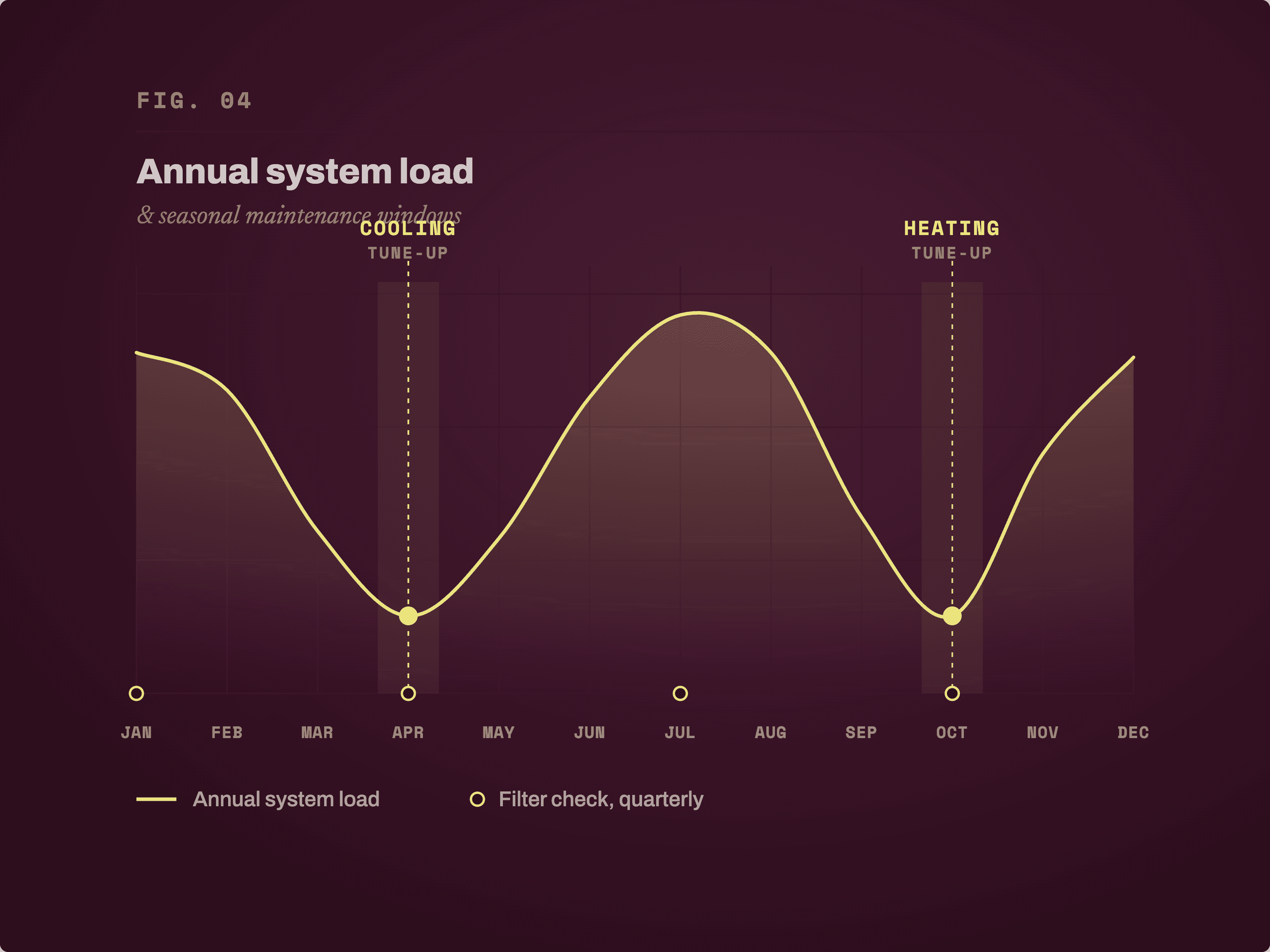
Twice annually for HVAC (spring before cooling season, fall before heating season). Annually for plumbing (water heater, supply lines, pressure regulator, drainage). Annually for electrical (panel inspection, GFCI/AFCI testing). Annually for roof. Biannually for gutters and exterior caulking. Concierge subscription combines these into a single calendar so you're not booking six separate appointments per year.
What's the biggest mistake homeowners make with preventative maintenance?
The most common pattern is intermittency — one year of strong discipline followed by three years of "I'll get to it next month." The cost compounds quietly during the dropped years, then surfaces all at once when something fails. The second most common mistake is over-relying on visual inspection — homeowners look for symptoms (drips, warm outlets, ceiling stains) when most early-warning signatures don't have visual symptoms yet.
Does preventative maintenance void manufacturer warranties?
The opposite, usually. Most major equipment warranties — HVAC systems, water heaters, sump pumps, sometimes appliances — actually require documented preventative maintenance to remain valid. Manufacturers know that a system without regular service fails earlier, and they don't want to cover wear that documented maintenance would have prevented. Keep the service records; they're worth real money at a warranty-claim moment.
A calmer way to think about your home
Preventative home maintenance works because failure is rarely sudden, and detection is rarely expensive. The systems are knowable; the signatures are readable; the catches are cheap relative to the misses. Most of what makes the model real is consistency over the years, and the gap between a homeowner's eye and a trained tech's eye on specific components.
That's the whole guide, distilled. If you'd like a number for your specific home, Home Maintenance Cost Calculator. If you'd like a person to walk through your home with you, schedule a home assessment. If you'd like to talk it through first before committing to anything, Talk to us first.
For the deeper companion content: The Real Cost of Home Maintenance for the cost spine and The Hidden Cost of Putting Off Home Repairs for the deferred-maintenance math.
Sources cited in this post
- NC State Cooperative Extension, Preventative Home Maintenance (Kirby, Zaslow, Herman, 2023) — content.ces.ncsu.edu
- Bob Vila, home maintenance cost guidance (1–4% of home value/year)
- National Association of Home Builders, Study of Life Expectancy of Home Components — nahb.org
- Harvard Joint Center for Housing Studies, Improving America's Housing 2025 — jchs.harvard.edu
- U.S. Department of Energy, HVAC maintenance and energy-use research (cited in Lennox technical reference)
- Energy Star, HVAC service-impact data (cited in United Air Temp technical guidance)