Our first year in our townhouse, I thought the mortgage was the budget. What I hadn't counted on was that we were buying a five-year-old house with five years of history already built in, and it didn't take long for that to become apparent. The first HVAC maintenance visit turned up mold inside the unit. We cleaned it, had UV lights installed to make sure it wouldn't come back, and tried not to dwell too much on the fact that we had a five-month-old at home. That was month one.
Over the five and a half years we lived there, more things found their way onto the list. The yard was graded toward the foundation instead of away from it, which sounds like a landscaping quirk until someone explains what that actually means for a house. (Short answer: not great.) A leak under the kitchen sink. A thermostat that chose a ninety-degree July afternoon to stop cooperating. A water heater that raised its hand and then, fortunately, stood down. The gutters, needing attention every fall whether we had remembered to schedule it or not. By the time we moved out, I had a very clear picture of what it meant to run a home, and it was not the number on the mortgage statement.
When we moved into our current place (a new build), I let myself be cautiously optimistic. No inherited problems. No deferred maintenance from someone else's backlog. The builder warranty would handle anything structural. Maybe we'd finally get a year where the house just... ran.
A year in, and it hasn't exactly run. More like a decent trot. New builds have their own surprises. In our case, small leaks where fittings are shifting as the house settles, a patch of sod that hasn't taken no matter what we have tried, nail pops appearing in the drywall like a slow inventory of all the places the walls have decided to move. It has also taken a full cycle of seasons to understand how the house handles heat and cold, with some rooms running warmer or cooler until the system finds its rhythm. The builder has covered those calibration visits while we have been figuring it out, but once the warranty ends, those calls are our responsibility. And there is something particularly optimistic about trying to keep a brand-new house looking new when your children have not gotten the memo that it is not, in fact, a jungle gym.
Two houses. Very different problems, but the same lesson both times: the mortgage is not the budget.
Owning a home in 2026 costs somewhere between $16,000 and $23,686 a year on top of the mortgage. The low end is Zillow's estimate; the high end comes from Clever's 2026 survey of 1,000 US homeowners. Neither number is wrong. They just count different things. And neither one is a DMV number, which matters, because the DMV has its own version of this math.
How much does it cost to own a home in 2026?
The most complete recent breakdown is Clever's 2026 homeownership cost study, a March 2026 survey of 1,000 homeowners. Their total for non-mortgage costs: $23,686 a year, or just under $2,000 a month.
| Cost | Per year | What it covers |
|---|---|---|
| Utilities | $7,679 | Electricity, gas, water, and the rest of the monthly stack |
| Maintenance | $5,162 | The upkeep that keeps your systems running |
| Renovations | $3,929 | Projects and upgrades, not repairs |
| Property taxes | $3,580 | Set by your jurisdiction |
| Homeowners insurance | $3,336 | Premiums have kept climbing nationally |
| HOA dues | $4,196 | Additional, for the 37% of homeowners in an association |
Two things in that number stand out. Utilities, not maintenance, is the biggest line item, running about 50 percent more than most people spend on upkeep. Almost nobody budgets for it that way, and I certainly didn't. And the $23,686 doesn't include HOA dues. If you're one of the roughly one in three homeowners who pays them, Clever puts the real total closer to $27,882, which is a significant number to be surprised by.
The gap between Clever's number and lower estimates like Zillow's mostly comes down to what each one decides to count. Some leave out renovations or HOA dues entirely. The framework you use matters more than the headline number.
Why do homeownership costs surprise almost everyone?
In Clever's survey, 82 percent of homeowners said their non-mortgage costs have gone up since they bought, and 45 percent said costs came in higher than they expected. That is a lot of people who got surprised by the same thing.
The buying process is not really set up to tell you what comes next. The affordability conversation at closing focuses on principal, interest, taxes, and insurance. Utilities and maintenance, the two biggest non-mortgage costs, tend to get glossed over. Not many people at the closing table ask what the electric bill looks like in August, or when the water heater was last serviced. You sign the papers on a number that is true but incomplete, and the rest shows up later, usually when it is least convenient.
The costs are also genuinely going up, not just being underestimated. Clever's renovation line alone is projected to grow from $3,929 to $6,359 this year.
How does the DMV change the math?
The national numbers are a starting point, but if you are in the DMV, it helps to do a little translation. A few things here push the numbers in a specific direction.
Climate matters more than most buyers realize. The DMV gets real summers and winters, the kind where heating and air conditioning are not optional and energy bills climb whether you are ready for them or not. An HVAC system working hard at both extremes of the year costs more to run and wears faster. That shows up in the utility and maintenance budgets.
How old the home is matters just as much. The average owner-occupied home in DC was built around 1941. In Loudoun County, it is closer to 2002. That gap is significant. A 1920s Georgetown rowhouse and a 2015 Ashburn build come with very different maintenance needs, and a lot of homes in and around the city lean toward the older end. Older bones can be beautiful. They can also be expensive.
Labor rates and taxes round it out. Skilled-trade wages in the Washington metro run above the national average, which lifts every line item that involves someone physically coming to do the work. Property taxes also vary across jurisdictions in ways that can catch buyers off guard: the same purchase price carries a meaningfully different tax bill in DC versus Fairfax versus Howard County. Your jurisdiction's actual rate is worth looking up before you trust any national average.
Why is the maintenance number the hardest to pin down?
Clever puts annual maintenance at $5,162. It is also the one line in their report without a named source. Every other category cites federal data. That is not a knock on the survey, but rather a sign of something real: nobody agrees on what counts as maintenance, which makes it very hard to measure consistently.
Credible guides put the number anywhere from about $5,000 to $18,000 a year for a DC-equivalent home, depending on what gets included. We walked through that source by source in The Real Cost of Home Maintenance in the DMV. If you want to see where the numbers come from, it is worth a read.
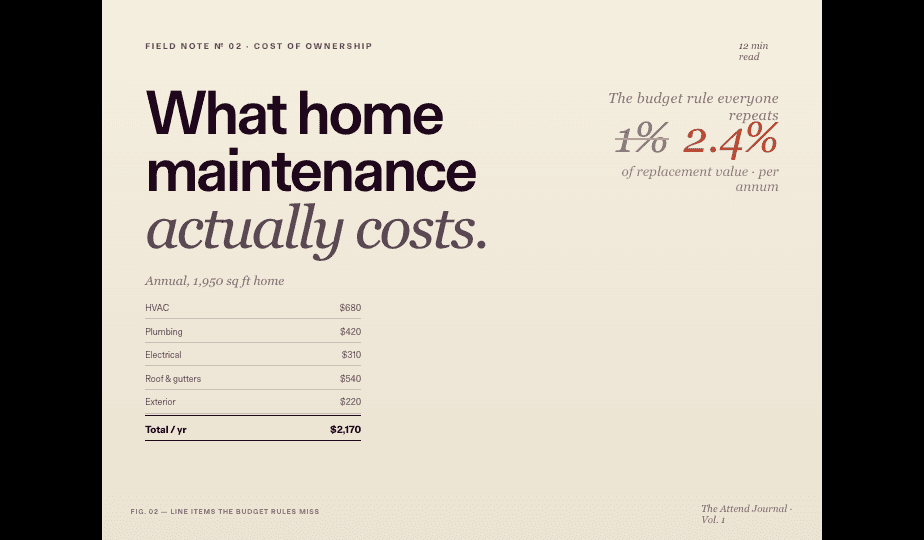
The number that tends to hold up better than any headline figure is the ratio: a dollar of maintenance done on schedule saves roughly four dollars in repairs later. Whatever your exact number turns out to be, when you do the spend matters more than how much.
How do you actually budget for all this?
Skip the perfect number and build a workable one. Nobody has the perfect number in year one anyway.
On maintenance, most guides land on one to four percent of your home's value per year, with older homes toward the higher end of that range. On utilities, the fastest honest answer is twelve months of bills from the previous owners. Most will share them if you ask, and nothing beats firsthand data. Taxes and insurance are best worked out with your jurisdiction's real rate and a current quote. National averages are a starting point, but not much more. If you want to nail down the maintenance number, our Home Maintenance Cost Calculator turns your home's details into an estimate in about two minutes. And Preventative Home Maintenance: A System-by-System Guide walks through what that number covers, system by system.
What changes when the cost stops being a surprise?
In Clever's survey, 63 percent of homeowners said they have deferred necessary maintenance because of cost, and 48 percent have no financial plan for major replacements. I read those numbers and feel them. Deferring is not carelessness. It is what happens when every expense seems to take you by surprise. When you do not know what is coming, waiting feels like the rational move. The real cost of that pattern is what we went into in The Hidden Cost of Putting Off Home Repairs. Deferred maintenance has a way of getting more expensive while you are not looking. Waiting is rarely the cheaper option.
What changes when the cost stops being a surprise is not that you suddenly sink money into catching up on everything you have been putting off. It is that you have a plan. Maintenance becomes a known number on a calendar, spread out at a pace that makes sense, so fewer things are sneaking up on you (which is where most of the real expense lives anyway). That is the shape of our membership: scheduled care, the same licensed technicians over time, and a lot fewer expenses that show up without warning.
If you want to know what your home needs, schedule a home assessment and we will walk through it with you. Or start with a conversation if you would rather begin there.
Owning a home costs more than the mortgage. About $2,000 a month more on the national average, and the DMV version tends to run higher than that. I wish someone had put that number in front of me before we closed on our first place. But here we are, two houses in, and the thing I can tell you is that knowing is better than not knowing. A cost you can see coming is a cost you can plan for. Everything else is just a surprise waiting to happen, and we have had enough of those.
What is the true cost of owning a home in 2026?
Between about $16,000 and $23,686 a year on top of the mortgage, per Zillow's and Clever's 2026 estimates. Clever's breakdown: utilities $7,679, maintenance $5,162, renovations $3,929, property taxes $3,580, and insurance $3,336. Homes in an HOA add about $4,196 on top of that.
How much should I budget for non-mortgage home costs?
A workable starting point is $1,700 to $2,000 a month, adjusted for your home's age, size, systems, and jurisdiction. For the maintenance piece alone, most guides converge on 1 to 4 percent of your home's value per year, with older homes toward the top of that range.
Are utilities or maintenance the bigger homeownership cost?
Utilities, and it is not close. Clever's 2026 study puts utilities at $7,679 a year against $5,162 for maintenance. Most people expect the reverse, which is one reason first-year budgets run short.
How does the DMV compare to the national average?
Higher on the labor-driven buckets. Skilled-trade wages in the Washington metro run above the national average, and the housing stock skews older, especially in DC and the close-in Maryland suburbs. Property taxes vary meaningfully across DC, Maryland, and Virginia jurisdictions, so no single number covers the region.
What happens to home costs if I defer maintenance?
They compound. The working ratio is that a dollar of maintenance skipped becomes roughly four dollars of repair later. Deferring is common, 63 percent of homeowners in Clever's survey have done it because of cost, but it is the most expensive pattern in homeownership.
Is owning a home really $23,000 a year?
For the average US homeowner, yes. Clever's 2026 survey of 1,000 homeowners puts non-mortgage costs at $23,686, and that excludes the mortgage itself. Households with HOA dues average $27,882. Your own number depends on your home's age, size, systems, and jurisdiction, which is why we built a calculator for it.